
David Tipling
Wilder Hickling – Phase 1: Development

This project is made possible with The National Lottery Heritage Fund, thanks to National Lottery players.
During the first phase of the project, our initial focus will be on enabling access to the Broad and supporting visitors to enjoy the area’s unique natural and social heritage.
Alongside this we will continue to work with partners, landowners and stakeholders to develop and implement plans to help the area’s wildlife and people adapt to the impacts of climate change.
Phase 1 development and delivery stages will take place until 2031, and will focus on:
Ecological resilience

Crane (credit: AdobeStock)
We will:
- Deliver plans for climate adaptation for key species by working to re-establish natural ecological processes.
- Identify opportunities for enhancing and expanding the area of land across the Upper Thurne that is managed with biodiversity as the prime or significant objective.
- Identify opportunities to protect and enhance the natural assets that contribute towards the sequestration and storage of carbon.
Deliverables will include:
- Reconnect 63 hectares of drained land within Hickling nature reserve reedbeds to Hickling Broad - re-establishing a larger, more resilient natural floodplain. In this area, we'll create additional pools, nesting islands, and reed-edge habitat to increase the diversity of habitats before breaching the old floodwall to allow water levels to naturally ebb and flow.
- Raise water levels across 45 hectares of publicly accessible marshes to create a shifting mosaic of tall herb fen and open water habitats supported by a dynamic and as close to naturally functioning water system as currently possible. We’ll adapt reserve infrastructure to the higher water levels, to retain public access to this area.
- Restore and introduce sustainable management of existing wetland scrapes, providing improved habitat for waterbirds and waders, and creating opportunities for close encounters with wildlife.
- Restore 45 hectares of wet grazing marsh, raising water levels, introducing new wet features to create additional foraging habitats and introducing conservation grazing.
Social impact

Boat of the Broads (credit: AdobeStock)
We will:
- Deliver visitor experiences which embody a ‘wild, wilder, wildest’ approach across Hickling Broad and Marshes to ensure the needs and expectations of a wider diversity of people are met, including young people and people with limited access to nature.
- Develop a recreation offer which is delivered with minimal impact to the sensitive habitats of the Broad and surrounding area.
- Develop and install innovative visitor infrastructure across the nature reserve such as raised viewing platforms rather than fixed hides so that it is adapted to cope with climate change and a changing environment.
Deliverables will include:
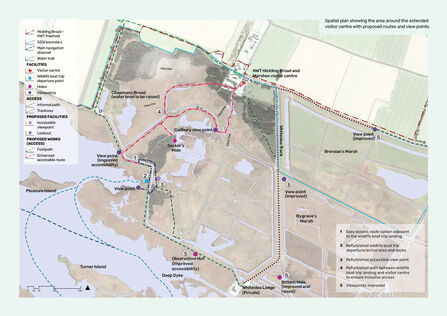
- Creation of an ‘experience arc’ around the northern edge of Hickling Broad to enable visitors to experience the natural environment and open water of the Broad through the creation of walks, viewing points and immersive moments.
- A new Welcome Cabin, which will be a focal point for connecting NWT Hickling staithe with the facilities at the NWT nature reserve by boat, cycle and foot.
- Enhanced trail from the NWT Hickling staithe to the existing NWT visitor centre at Hickling Broad, to make the nature reserve more accessible to visitors on foot through specific small-scale interventions such as path improvements and signage.
- Extended visitor experience at the nature reserve, including the development of new walks, viewing points and wildlife experiences so that it becomes more inclusive and accessible to a wider diversity of people.
- Installation of a changing places toilet at NWT Hickling staithe as part of our commitment to accessibility.
- Working with the Nancy Oldfield Trust to enable the provision of fully accessible boat trips which will run from NWT Hickling staithe.
Economic sustainability

EV charging (credit: AdobeStock)
We will:
- Ensure that the expansion of the visitor offer continues to support local employment and volunteering opportunities through direct employment as well as supporting services including hospitality and tourism.
- Work closely with our landlord tenants at the Pleasure Boat Inn to optimise the visitor experience and support the pub in being a successful enterprise.
Deliverables will include:
- EV charging points installed for cars and electric bikes across the NWT car park facilities at Hickling.
- Development of a business case including income-generation opportunities to support the
future economic resilience of our work for nature and wildlife as well as the local tourism industry. - Building on the success of the newly renovated Pleasure Boat pub by working with our tenant Landlord to encourage and engage a new audience to ensure the longer-term sustainability of the business.
Heritage enhancement

Building restoration (credit: Jake Luke Harrold flooring)
We will:
• Find innovative ways to tell the story of the Broads, its natural and social history and impact.
• Deliver memorable experiences that encourage visitors to find out more about the heritage of the site.
• Undertake sensitive building restoration which preserves the built heritage of the site.
Deliverables will include:
• Sensitive, appropriate and accessible interpretation across the site which helps to tell the natural and social history of Hickling Broad and Marshes.
• Car park improvements to ensure from the point of arrival the natural heritage of the site is evident, through using reed and sedge to ‘naturalise’ the boundaries, blurring lines between the built and natural environments.
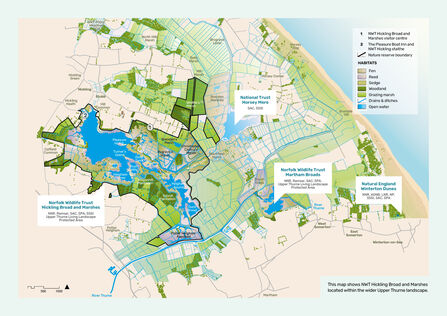
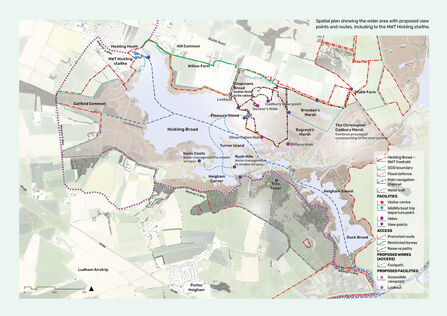
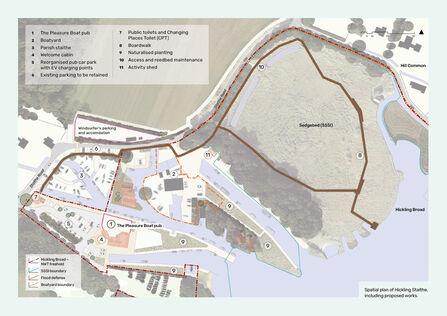
Read more about Phase 1 of our vision for a Wilder Hickling
- Hickling Vision Booklet 2026 (6.5 MB)
- Hickling vision booklet - plain text version (36.48 KB)